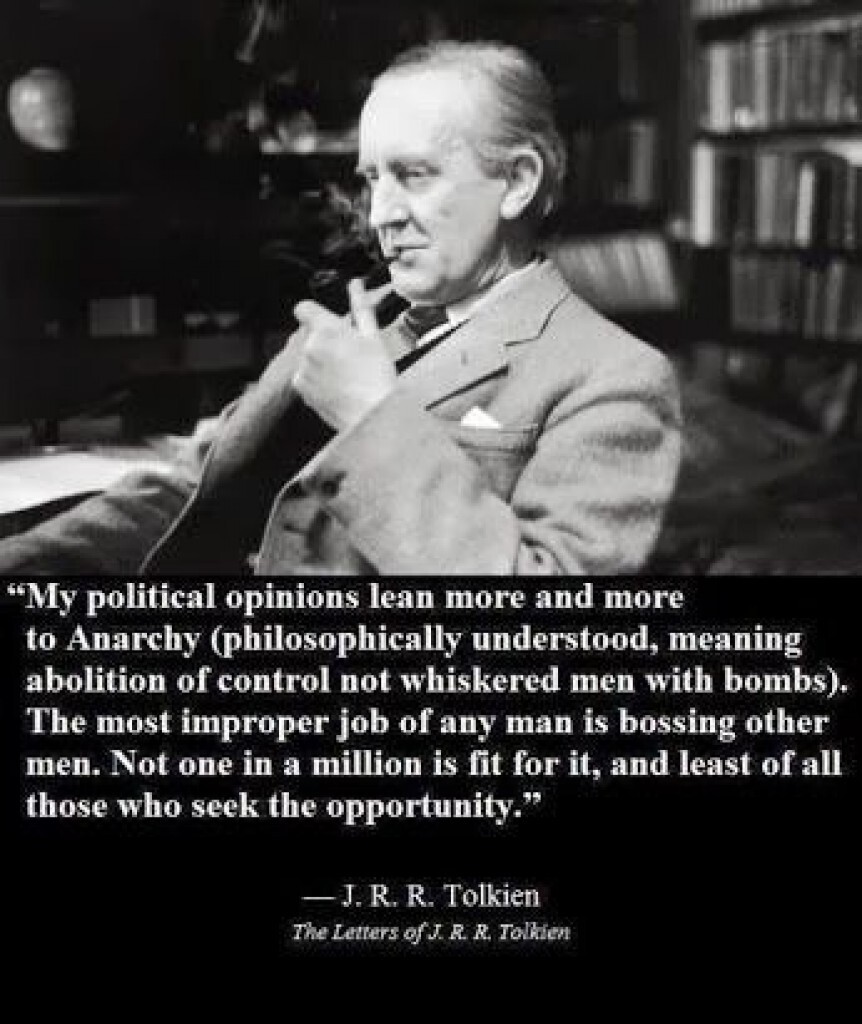
A man who lived through WWI and understood the power of the state by his wartime experience: J. R. R. Tolkien. His works show a great spectrum of political power structures which span from pure and free to evil and controlling. Tolkien was an anarchist. Think about the journey from the Shire to Mordor: The hobbits live in the freedom of the Shire. They have no formal government and live in anarchy. As they travel east, they witness varying levels of increasing control and corruption. Rivendell is the perfect platonic republic under the care of the 'wise rulers'. But it is rigid and constrained by Elrond. Its success depends upon the longevity and nearly incorruptible nature of the elves. Yet Rivendell is a step down in freedom from the Shire. In spite of the strong will and high character of the elves, it is still Bilbo, a hobbit from the freedom of the Shire who is selected to carry the ring. Even an elf would succumb to its power. If the Ring is state power, then only the most free can hope to survive it’s influence. Orthanc and Saruman himself show the danger of trusting in a wise leader. When danger threatened from Mordor, Saruman took the easy path of bending to evil. His power was flipped from serving good to spreading corruption and death. When it came down to a choice, he chose power for himself over freedom, and even life, for others. Rohan is a loose feudal monarchy held together by Theoden. Tolkien shows us the danger of a wise ruler being corrupted by evil through Saruman's agent, Gríma Wormtongue. The nation nearly falls to the orc invasion because of the corrupting power of Saruman, Sauron and the Ring. Gondor is a crumbling empire that has finally succumb to its own size and lack of wise leadership. The reigns of power still remain to be abused by the insane Denethor, Steward of Gondor. He becomes so desperate and trapped in his own madness that he refuses to call for aid. When Denethor commits suicide in despair...