What Did The Druids Do For Us

I passed my childhood and early adolescence in Shropshire so I always get a warm feeling when the rural county is in the news for good reasons. One of the 'good reasons' that has put Shropshire in the news most frequently over the past few years is archaeological discoveries revealing much about that poorly understood era before the Romans arrived in Britain.
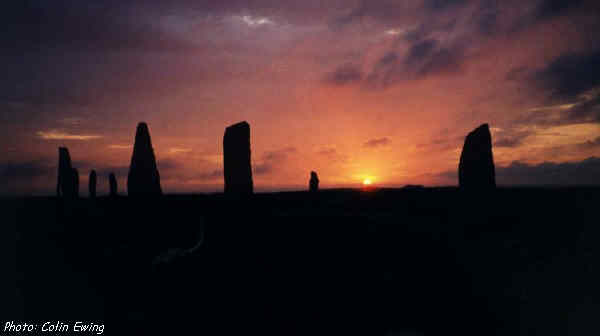
What did the Romans do for us is a question asked originally in the comedy film Monty Python's Life Of Brian and since then often repeated by people sceptical of the formative role in building western civilisation given to the Roman Empire by orthodox historians. What did the Druids do for us? might be a more appropriate question. The discovery of a road in Shropshire that was built by pre-Roman engineers gives us a big hint that the indigenous Britons of the iron age were much more technically advanced than historians since the medieval period cared to acknowledge. The unearthing of the ancient road in Shropshire is not the only evidence of that however; the Celtic smiths were much more advanced in metallurgy and in applying their superior steel to various tasks that the crude iron bashers of Rome. In astronomy, the healing arts and in organising society in a fair and inclusive system the Druids and the Celtic craftsmen also outdid the artisans of Rome.
So why were we encouraged to think of the Celtic and Gothic tribes of northern Europe as ignorant savages? Well it is traditional that the victors get to rewrite history casting themselves as the good guys and Rome, first Imperial Rome and then the Christian rulers of The Holy Roman Empire won the military conflicts and told the story from their point of view.
But what, if anything, did the Romans <EM>really</EM> do for us?
The Shropshire road itself tells its own chapter of the real story well. The route had long been marked on maps as a Roman road, named Margary No 64 after the man who first mapped what everyone assumed to be the country's earliest transport network. It could be seen as a low earth rampart or as a line of lesser growth through cornfields. In 1995 archaeologists dug up a bit. Sure enough, it looked like a typical Roman Road.
In 2009, when excavations by Tarmac Construction Corporation was due to destroy a section of it, a heritage agency order for preservation of antiquities gave archaeologists the opportunity to explore a long section of road, some of it, as it turned out, extremely well preserved. At first, it still looked Roman, from its cambered, cobbled surface on a metre of hardcore and a clay base, to the ditches at the sides in which a scattering of Roman rubbish could be identified. Project leader Tim Malim noticed however that the road had twice been rebuilt. Knowing he was onto something special he decided to date the road remnants using a technique that determines age by showing when buried mineral grains were last exposed to sunlight.
The unexpected result was a more than 80% chance that the last surface had been laid before the Roman invasion in AD43. Wood in the roadbed was radiocarbon-dated to the second century BC, sealing the road's pre-Roman origin. And Malim thinks a huge post that stood in 1500BC close to the crest of the hill was a trackway marker. While Roman roads did not use wood, Celtic roads found in Ireland typically have a wooden bed with a hardcore layer topped by stone paving slabs. It is a method ideally suited to making roads through wetlands of Ireland;'s boggy interior or the English Marcherlands.
When the Roman army marched around its new conquest, the officers being pragmatists adopted the road the road as their own, Romanising it to provide a Chariot or Legionnaire friendly pathway.
Recently the trendier archaeologists and ancient historians have become willing to discuss how much British pagan society was really "Romanised". There is no consensus but in spite of the numerous villas with central heating and public statues of Roman emperors, in spite of the towns with their aqueducts, public baths, amphitheaters and sewers, some academics insist the four centuries of Roman occupation as a mere ripple on the longer and stronger flow of native culture and politics.
Could the reverse have been true and Britain been more in line with Roman civilisation than was ever supposed before it was invaded? What does route 64 tell us when we travel along it back through time?
The existence of such a road implies not just that its constructors had technical and organisational skills equal to Rome but they had those skills before the Roman Empire existed., Also the cost of such a venture could only be justified if there was sufficient traffic to necessitate a rapid transit system between centres of population. Thinking in these terms we go beyond the standard view of social development among the Ancient Britons where, according to the narrative left us by the conquering Romans, wheeled vehicles appear only in battle, featuring in daredevil displays of reckless chariot driving.
Long before the Roman invasion, archaeological evidence testifies the British landscape was well organised with a dense network of fields and tracks. Larger settlements were towns in all but name, where homes were separated from industrial areas by streets, and social functions such as food storage, slaughterhouses, tanneries, smiths and metal workers and religious ritual had their separate places. Baths, medicines, skilled arts and crafts, perhaps even forms of currency – such things were commonplace. What really seat these people apart from the Romans was that they seldom built in stone. It is for this reason the impression given by Roman writers that the image of ancient Britons (like the Germanic tribes, the French and Iberian Celts and the Goths) as ignorant savages stood up so long. Rome, like Greece, Babylon and Egypt left a permanent reminder of its achievements. The Britons burned and rebuilt in a ritual act of cleansing and renewal.
A more open minded attitude in archaeology is revealing that before they were invaded, Britons were more aware of Rome than Rome was of Britain. This is seen no more clearly than in a cemetery near Colchester, Essex, excavated mostly in the 1990s at, as it happens, another Tarmac quarry. Some very special people had been buried there. They weren't leaders, but members of the ruling class who had died between about AD40 and AD60: it's conceivable that some of them actually saw the invading Roman army, but they had grown up and learned their skills long before. There is nothing about their graves that looks in the least bit Roman. One of the men could have been a Druid.
Another seems to have been a doctor. This man had his wine jar, his imported pottery service and copper vessels. But he also had a set of surgical instruments – one of the oldest known in the ancient world. The tools are recognisably functional – scalpels, forceps, probes and more, all comparable to finds made around the Roman empire.
In the traditional burial ritual observed throughout the ancient world the dead were buried with their most precious possessions. The treasures these people took with then at first glance shout 'Rome'.These include a beautiful blue glass jar of a type more typically found in the Mediterranean region around the time of the birth of Christ, that probably held a cosmetic. There is a pottery inkwell: did its owner write? One man took with him a large Italian wine jar and a copper jug and basin set, such as was common in Pompeii; an amber-coloured glass bowl may have been made in Italy. it is dangerous to assume that Roman flavoured objects would require Roman skills in their manufacture.
The Romans were not great craftsmen but great soldiers and administrators. They imported technical skills, architects, builders, craftsmen, poets, philosophers and metal workers from around the Empire, from Greece, Egypt, Phonecia, Assyria, Persian and it seems, possibly from Britain.
The treasures found in the Colchester burial ground are not Roman however, nor do they originate from the eastern end of the Mediterranean when so many ancient civilisations met and made war. On the best evidence currently available the items were made in Britain to designs that merely borrowed from Greece and the middle east. To throw a little more light on this mystery we must turn to Robert Graves' book The White Goddess. Although Grave's was exploring the spread of the Goddess myth across the prehistoric world from Britain and Ireland in the west to the Himalayas and northern India he does refer to factual history often. One of the sections he devotes to what has been confirmed by archaeology deals with a trading system that spread goods from one community to another from Scandinavia and the British Isles, all around the shores of the Mediterranean Sea and down the west coast of Africa to the delta of the River Niger and possibly beyond.
If artefacts reached so far it is fairly certain cultural influences did too.
Archaeology is a science and deals in what is know; history in years and eras, distances in miles and cultures by their distinguishing marks. If something looks Roman, an archaeologist will probably call it Roman unless there is a strong reason to doubt that. Dating technology may be imprecise and unable to pinpoint an artefact to a particular decade or the reign of a specific ruler still less an actual history event. It can put us in the right area however. Shropshire's pre - Roman motorway then comes with enough empirical evidence behind it to suggest it might make orthodox academics and historians reconsider the way we see the early Britons.
RELATED POSTS:
Alchemy For Beginners - Part 1: A Condensed history Of Alchemy
Religion and Science have in recent times not been comfortable bedfellows. Strange then that the earliest scientists were priests, people who chose todevote their lives to the pursuit of knowledge and understanding. One early science much derided by modern scientists was Alchemy, the quest to turn base metals like lead into Gold. But was the althemists idea reeally daft?
What Did The Romans Really Do For Us?
Bog Butter
Rievaux Abbey
Land of Dragons and Druids - part 1
Whalley Abbey