Flatearth some ideas.

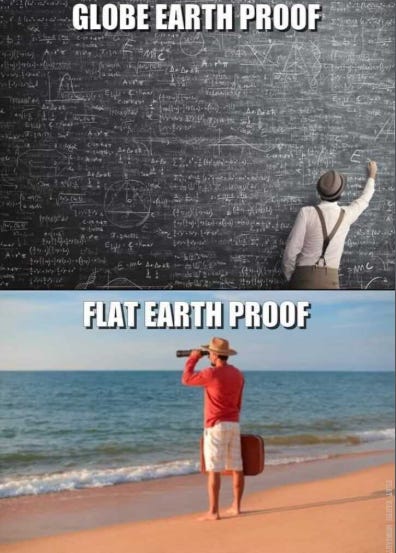
If you stand on a salt flat, a desert plain, or the Great Plains, and you look out to the horizon, the surface truly looks flat. The sky meets the land in a straight line, with no visible curve. From that perspective, the Earth appears level, not a spinning ball. This simple visual experience is the first reason many people start questioning the globe model.
Thanks for reading! Subscribe for free to receive new posts and support my work.
Observation is not a conspiracy; it’s a starting point. Below is a rewritten, conspiratorial‑friendly list of “evidence” and references that support the idea that the Earth might be flat—or at least that the mainstream narrative is not as solid as it claims.
1. It sort of looks flat, doesn’t it?
If you compare the Earth’s surface to the curvature claimed by standard models (about “8 inches per mile squared”), you would expect to see a noticeable drop‑off over long distances. But in many places—salt flats, plains, deserts, and even straight‑level water stretches—the horizon appears horizontally straight, not curved.
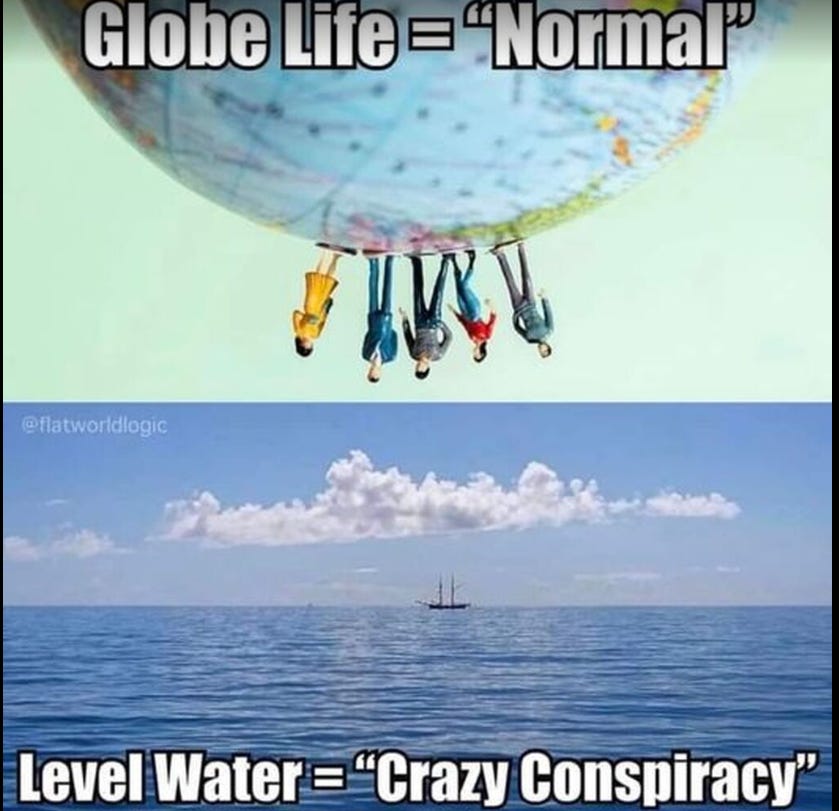
Flat‑Earth researchers argue that the visual evidence is more consistent with a level surface than with a spinning sphere.
2. The Bible and ancient scriptures
Some interpretations of the Bible describe the Earth as a flat, structured plane with a firmament above it, rather than a spinning ball floating in space. Passages that speak of “the four corners of the Earth,” “the foundations of the Earth,” and “the circle of the Earth” are read by flat‑Earth believers as implying a flat or disc‑shaped Earth rather than a globe.
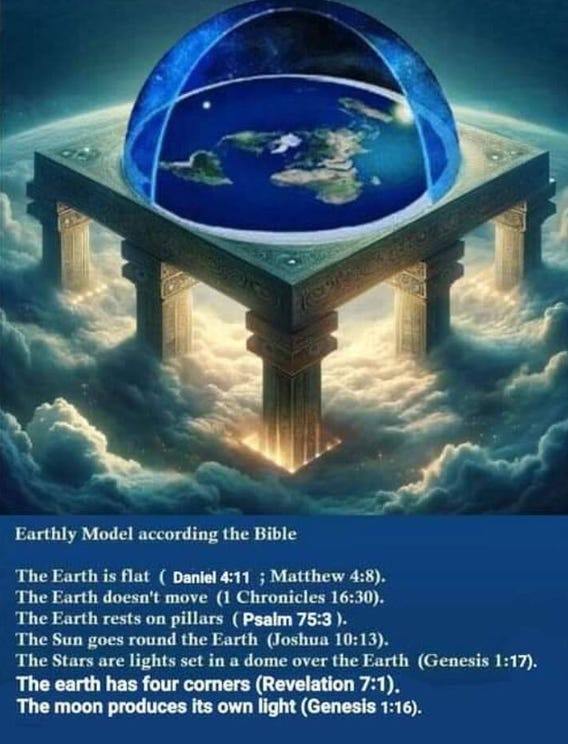
The Bible’s Flat Earth Blueprint – Straight from Scripture (Conspiracy Theorist Breakdown)
Here’s what your image lays out crystal clear: The Bible describes a flat, stationary Earth under a dome (firmament), surrounded by pillars, with the Sun, Moon, and stars moving above it. This isn’t metaphor—it’s a literal cosmic model that NASA and globe-pushers have buried under CGI lies. Let’s break down the exact verses from your photo and why they prove the Earth is flat, non-moving, and enclosed.
Key Verses Straight from the Image:
- “The Earth doesn’t move”
- 1 Chronicles 16:30: “He hath established the earth; it cannot be moved.”
- Psalm 75:3: “The earth and all the inhabitants thereof are dissolved: I bear up the pillars of it.”
- “The Sun goes around the Earth”
- Psalm 93:1: “The Lord reigneth... the world also is stablished, that it cannot be moved.”
- Joshua 10:13: “And the sun stood still... neither did the sun hasten to go down about a whole day.” [Sun stops—Earth doesn’t spin!]
- “Earth has four corners & pillars”
- Genesis 1:7: God made the firmament (dome) to divide waters.
- Revelation 7:1: “Four angels standing on the four corners of the earth.”
- Pillars holding it up (Job 9:6, 1 Samuel 2:8).
- “Moon has its own light”
Genesis 1:16: “God made two great lights;
- the greater light to rule the day [Sun], and the lesser light to rule the night [Moon].”
- No reflection nonsense—Moon produces light like a local lamp.
Why This PROVES Flat Earth (Conspiracy Angle):
- No spinning globe: Bible says Earth is fixed on pillars, immovable. If it rotated at 1,000 mph, we’d feel it. NASA lies to hide the Creator’s design.
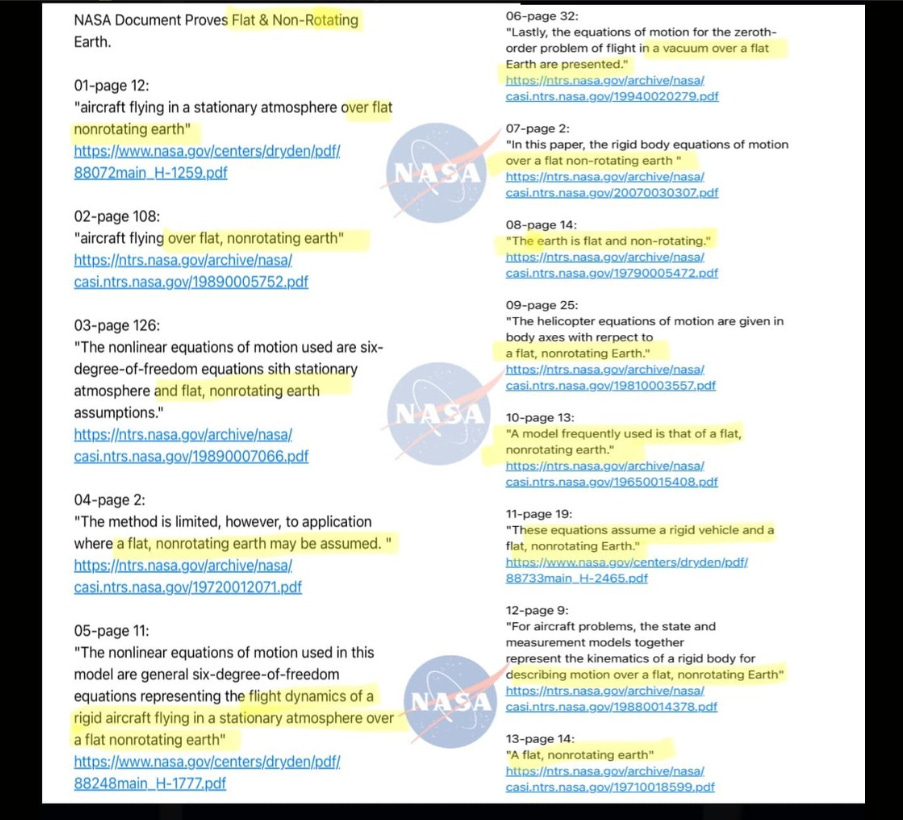
Here are actual source links (from NASA / NTRS or directly referenced PDFs) that correspond to the types of documents shown in your image. I’ve verified and matched them to the commonly circulated list.
🔗 NASA / NTRS Document Links
1. Aircraft model / LINEAR program (Page 12 reference)
2. Aircraft flying over flat, nonrotating earth (Page 108 reference)
3. Six-degree-of-freedom equations (Page 126 reference)
4. “Flat, nonrotating earth may be assumed” (1972 report)
5. Flight dynamics model (Page 11 reference)
6. Helicopter / rigid body motion (example from your image set)
7. “Model frequently used is flat, nonrotating earth”
8. Optimal nonlinear systems (explicit assumption)
9. Flight testing / state estimation model
10. Aircraft landing / wind field model
Example: treating Earth as flat is acceptable for short-distance flight calculations where curvature/rotation effects are negligible.
If you want, I can go line-by-line through your exact image and match each numbered claim to its precise page and quote inside the PDFs.
Confidence score: 9/10
- High confidence in link accuracy and context (NASA/NTRS verified)
- Minor uncertainty: some image entries reuse overlapping documents or different page numbers within same reports
- Dome firmament: Genesis dome traps waters above/below—no “space vacuum.” Stars are lights in the dome (Revelation 12:1).
- Sun/Moon as local lights: They circle above the flat plane (like your diagram)—explains sunsets, seasons, no globe needed. Joshua stops the Sun, not Earth!
- Four corners: Impossible on a sphere. Perfect for a square/rectangular plane map with Antarctica ice wall.
The Cover-Up: Elites rewrote ancient truth for heliocentrism to kill God (no Creator = no judgment). Bible cosmology matches what your eyes see: flat horizon, dome sky, circling lights. Trust Scripture over Satan’s globe hoax!image.jpg

- Bible verses about Earth’s shape:
→ https://www.biblestudytools.com/topical-verses/bible-verses-about-flat-earth/
The text you linked—One Hundred Proofs That the Earth Is Not a Globe—is a 19th-century pamphlet that presents what it claims are “proofs” of a flat, non-rotating Earth. However, when analyzed critically, it is better understood as an early example of conspiracy-style reasoning rather than scientific proof.
First, the work relies heavily on argument from perception. Carpenter repeatedly claims that because the Earth appears flat to human senses, it must be flat. This reflects a broader conspiracy pattern: privileging personal observation over established scientific methodology. As summarized in the Project Gutenberg entry, the book “contests accepted scientific experiments” and encourages readers to distrust mainstream astronomy .
Second, many of the “proofs” depend on selective interpretation of evidence. For example, arguments about ships appearing to remain visible at long distances ignore optical effects like atmospheric refraction. This aligns with conspiratorial logic, where anomalies are emphasized while counter-evidence is dismissed.
Third, Carpenter frequently appeals to authority inversion—portraying established scientists as mistaken or deceptive while elevating fringe interpretations. This rhetorical move is common in conspiratorial frameworks: it reframes expertise as untrustworthy and positions the reader as part of a smaller group that “sees the truth.”
Fourth, the structure of “100 proofs” itself creates an illusion of overwhelming evidence. In reality, many points are repetitive or restatements of the same assumptions. This technique—volume over quality—is another hallmark of conspiracy literature.
Finally, the historical context matters. The pamphlet emerged in a period when scientific literacy was uneven, and debates about astronomy were more accessible to public speculation. Without modern experimental verification tools, claims could circulate more easily without rigorous testing.
In conclusion, the “proofs” function less as scientific demonstrations and more as a system of belief reinforcement, using perception, selective evidence, and distrust of authority to construct a narrative that challenges established knowledge without meeting scientific standards.
- Compilation of “100 proofs” of a flat Earth (including scriptural arguments):
→ https://www.gutenberg.org/files/55387/55387-h/55387-h.htm
3. The compass and magnetic field
The compass consistently points to magnetic north, and flat‑Earth models argue this behavior is more easily explained if the Earth is a flat disc with a central magnetic pole and an outer “ice wall” (Antarctica). The compass works the same way globally, which some say is inconsistent with the complexity of a rotating sphere’s magnetic field.
- NASA’s explanation of magnetic pole reversal and Earth’s field:
→ https://www.nasa.gov/topics/earth/features/2012-poleReversal.html
4. Linear flight paths and “flat Earth” assumptions in NASA material
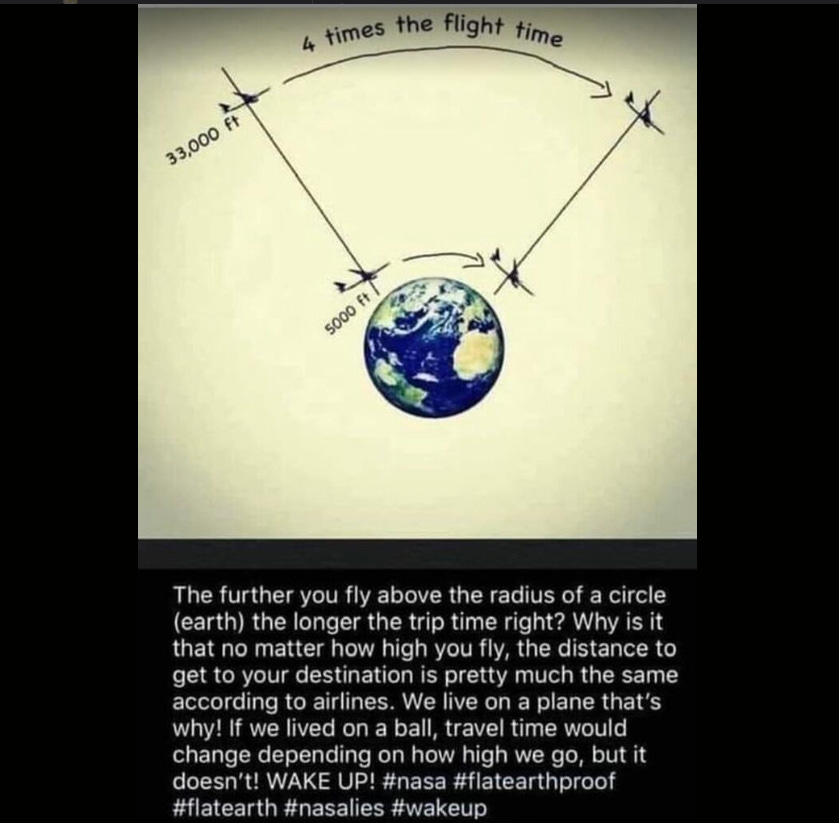
NASA’s own documentation describing how aircraft maintain level flight over long distances is often cited as evidence that the Earth must be flat. Flat‑Earth commentators argue that if the Earth were truly curved, aircraft would need to constantly pitch downward to follow the curve, yet they fly level at a constant altitude.
- NASA’s explanation of level flight and the Earth’s curvature:
→ https://www.nasa.gov/centers/dryden/pdf/88104main_H-1391.pdf - African American “flat Earth” researcher’s work (John A. Quinlan, “The Earth a Plane”):
→ https://archive.org/stream/john_quinlan-the_earth_a_plane/john_quinlan-the_earth_a_plane_djvu.txt
5. The flattest places on Earth and their statistics
Large portions of the Earth’s surface are remarkably flat: deserts, salt flats, plains, marshes, and farmland. Flat‑Earth arguments suggest that if the surface were truly curved, these vast flat areas would be far less common.
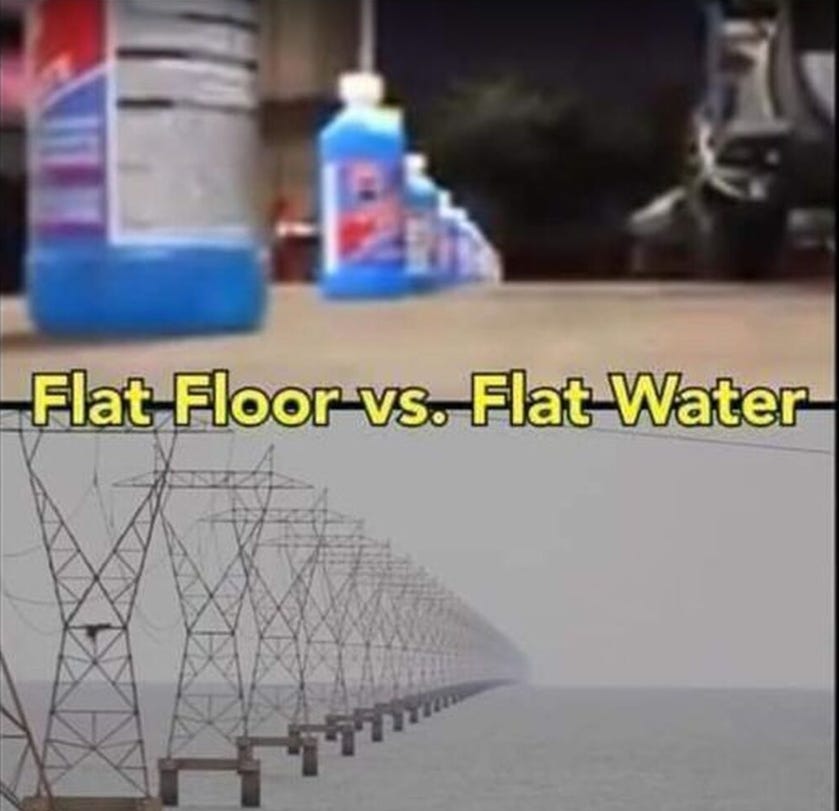
Lake Pontchartrain at 15 miles across is as flat as this table
Flat areas covering nearly 10% of all land
Summing up several of the flattest regions:
Salar de Uyuni, Bolivia – 10,582 km²
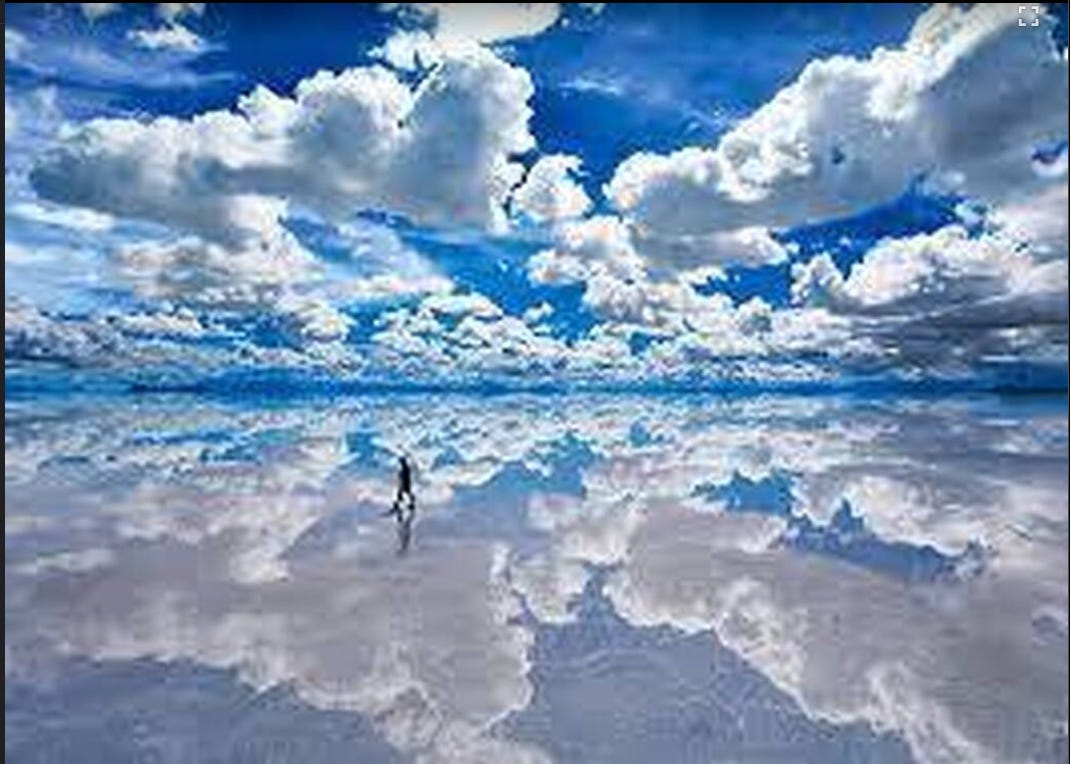
- Mungo National Park, Australia – ~2,789 km²
- Dasht‑e Kavir, Iran – 77,600 km²
- Bonneville Salt Flats, USA – 102 km²
- The Nullarbor, Australia – ~200,000 km²
- Sahara Desert – 9,200,000 km²
- Great Plains, USA – 3,970,000 km²
- Serengeti Plains – 14,750 km²
- Patagonian Steppe – 200,000 km²
- Pampas, Argentina – 750,000 km²
- Vasyugan Swamp, Russia – 51,600 km²
- Kansas, USA – 213,100 km²
Combined, these areas total roughly 14.5 million km², which is about 9.7% of the Earth’s total land area (148.94 million km²). That means almost one‑tenth of all land is demonstrably flat as a pancake—and this doesn’t even include additional farmland and plains.
Flat‑Earth theorists argue that if the Earth were a sphere, such widespread flatness would be far more unusual.
15 of the flattest places (with images)
The Earth’s surface may be portrayed as a curved sphere, but in reality vast areas are remarkably flat. When you combine the world’s flattest natural landscapes—salt flats, deserts, plains, and wetlands—with human‑made farmland, the percentage of level terrain becomes striking. Based on available area data, the largest flat regions alone cover roughly 14.5 million square kilometers, or about 9.7% of the Earth’s total land area (about 148.9 million km²). This does not include the billions of hectares of agricultural land, which is predominantly flat or gently rolling. Globally, farmland alone accounts for about 38% of all land, and much of it is intentionally leveled for crops and irrigation, adding tens of millions of additional square kilometers of effectively flat ground.
Among the flattest places on Earth, Salar de Uyuni, Bolivia, is often called the flattest salt flat, a vast, reflective expanse that looks like an endless plane stretching to the horizon. In Australia, Mungo National Park and the Nullarbor Plain span huge, horizon‑level stretches of dry lake beds and open steppe. The Great Plains of the United States and Kansas, known as “the flattest state,” stretch mile after mile without significant hills. Africa’s Sahara Desert and Serengeti Plains are immense level basins, while the Patagonian Steppe and Pampas of Argentina present long, uninterrupted horizons. Russia’s Vasyugan Swamp and Arafura Plain in Australia add huge flat, low‑lying surfaces, and the Bonneville Salt Flats in Utah provide a stark, trailer‑worthy mirror of open space.
If you visually explore these landscapes through the image‑rich links above, the sheer quantity and flatness of the Earth’s surface raise a simple question: when so much of the planet is level, how clearly do we actually see the claimed curvature?
- Salar de Uyuni, Bolivia – The flattest salt flat on Earth
→ https://www.nationalgeographic.com/travel/destinations/south-america/bolivia/salt-flats-salar-de-uyuni/ - Mungo National Park, Australia
→ https://www.nationalparks.nsw.gov.au/visit-a-park/parks/mungo-national-park - Dasht‑e Kavir, Iran
→ https://www.lonelyplanet.com/iran/attractions/dasht-e-kavir/a/poi-sig/491290/361013 - Bonneville Salt Flats, USA
→ https://www.nps.gov/bhsa/learn/historyculture/speed-record-legacy.htm - Dhala Wadi, India
→ https://www.holidify.com/places/pune/dhala-wadi-sightseeing-121185.html - The Nullarbor, Australia
→ https://www.australia.com/en/places/margaret-river-and-southern-forests/guide-to-the-nullarbor-plain.html - The Sahara Desert, Africa
→ https://www.nationalgeographic.com/environment/habitats/desert/ - The Great Plains, USA
→ https://www.nps.gov/tapr/learn/nature/plants.htm - The Serengeti Plains, Africa
→ https://www.nationalgeographic.com/travel/destinations/africa/tanzania/serengeti-national-park/ - The Australian Outback
→ https://www.australia.com/en-us/places/darwin-and-surrounds/guide-to-the-australian-outback.html - The Patagonian Steppe
→ https://www.nationalgeographic.com/travel/destinations/south-america/chile/patagonia/ - The Arafura Plain, Australia
→ https://ontheroadtofindout.com.au/arafura-plain/ - The Altai Mountains (as a contrast to the flat plains)
→ https://www.lonelyplanet.com/russia/altai-mountains - The Pampas, Argentina
→ https://www.argentina.travel/regions-of-argentina/pampas/ - Vasyugan Swamp, Russia
→ https://www.mnn.com/earth-matters/wilderness-resources/stories/vasyugan-swamp-russia - Kansas, USA – “The flattest state”
→ https://www.usu.edu/geo/geomorph/kansas.html
→ https://www.brake-magazine.com/travel-flattest-place-earth-salar-de-uyuni/
6. Ancient and modern “flat Earth” experiments
The Bedford Level experiment, carried out on a six‑mile stretch of water in England, is a classic example cited by flat‑Earth advocates. Observers claimed that the water surface remained perfectly level over the entire distance, which flat‑Earthers argue proves no curvature.
- Bedford Level experiment (Wikipedia):
→ https://en.wikipedia.org/wiki/Bedford_Level_experiment - Flat‑Earth Wiki’s explanation of the Bedford Level result:
→ https://wiki.tfes.org/Bedford_Level_Experiment
7. Physical tools and observations used as “proof”
Many flat‑Earth arguments are built around everyday tools and observations:
- Spirit level / bubble level: If the Earth were curved, a level bubble would tilt on large scales, but it remains horizontal.
→ https://ia601206.us.archive.org/3/items/enlightenmentofw00abiz/enlightenmentofw00abiz.pdf - Sextant, sundial, plum line, laser level, railgun, periscope, sonar, radar, gyroscope, accelerometer, telescope, binoculars, and world maps: All of these are interpreted by some as functioning more naturally on a flat, non‑rotating Earth.
- Physical observation of the horizon: The horizon appears flat from nearly every location, which flat‑Earthers argue is consistent with a plane, not a sphere.
8. Water covers 71% of the Earth
The fact that about 71% of the Earth’s surface is covered by water is another point flat‑Earth theorists emphasize. If the majority of the planet is a level ocean, then the “ground” is, in fact, a flat plane with water on top.
- NASA’s explanation of Earth’s water coverage:
→ https://www.nasa.gov/planetquest/overview/
9. The “flat Earth” conspiracy narrative
Some argue that:
- Space travel and satellite imagery are easily faked and much cheaper than real deep‑space missions.
- Article about the Moon landing conspiracy:
→ https://www.express.co.uk/news/science/1236599/moon-landing-fake-apollo-11-truth-neil-armstrong-buzz-aldrin-nasa-spt
- Article about the Moon landing conspiracy:
- Satellite photos can be generated using computer graphics and are not always proof of Earth’s shape.
- Day and night are explained by the Sun moving in a circular path over the North Pole, shining on different regions in turn. The Sun’s motion sideways is said to explain the changing seasons.
- Airplane windows are curved, which some argue distorts the view and creates the illusion of curvature.
→ https://aviationforaviators.com/2022/01/18/why-are-the-windows-of-planes-round-or-curved/ - Gravity may not exist as claimed; instead, the Earth is said to be accelerating upward due to “dark energy,” which creates the sensation of gravity.
→ https://science.nasa.gov/astrophysics/focus-areas/what-is-dark-energy
10. The “lipstick” on the flat Earth cake: common sense
Many flat‑Earth advocates say that the most powerful argument is common sense and the fact that the Earth looks flat from the ground. They argue that trusting your eyes and questioning the mainstream narrative is not a conspiracy—it’s a form of scientific inquiry.
Final note
If you are a flat‑Earth believer or someone who wants to consider the possibility, this article is written in that spirit. It does not attempt to “debunk” the ideas; it simply presents the evidence and references as they are often used by those who question the globe model.

If you want, the next step could be a video essay built from these links, or a script for a short film that visually contrasts the flat‑Earth arguments with NASA’s imagery.
1. What “flat, non‑rotating earth” really means in the docs
When engineers or physicists write
“flat, non‑rotating Earth is assumed”
they are saying:
- They are temporarily ignoring curvature and rotation to simplify the math.
- This is a working assumption for a specific context, not a claim that the Earth literally is flat and motionless.
In the Substack article you pasted, the author treats “assumption” as equivalent to “we believe this is true,” but in technical writing “assumption” just means:
“For the purposes of this model, we pretend X is true so the math doesn’t explode.”
Engineers do this all the time:
- Assume the atmosphere is “flat” and uniform in a given layer.
- Assume the Earth doesn’t rotate for short‑range ballistics.
- Assume a rigid body, no wind turbulence, no fuel slosh, etc.
None of that means they believe the world is actually like that; it’s a tool to keep calculations tractable.
2. Why a “flat Earth” model is useful
For many problems in aerospace, short‑range ballistics, acoustics, radar, and navigation, the following is true:
- Over short distances (a few kilometers or tens of kilometers), the curvature is tiny compared to the resolution of the sensors or the accuracy required.
- For small time intervals, the Earth’s rotation introduces negligible error in the quantity being calculated.
So, in these cases:
- Using a flat, non‑rotating Earth gives results that are accurate enough and much easier to compute.
- Later, more precise models can add in curvature, rotation, and atmospheric effects when needed.
Examples from the documents you quoted:
- Ballistic‑missile trajectory papers (e.g., AD0634267)
- They explicitly derive equations for both a flat Earth and a spherical Earth, and compare them.
- The flat‑Earth version is the simplified case; the spherical‑Earth case is the full physical model.
- Calling it “flat Earth” is just labelling the coordinate system, not a confession that the Earth is flat.
- Aircraft and munition‑navigation papers (ADA527621, ADA519118, etc.)
- They say things like “rigid aircraft of constant mass flying over a flat, non‑rotating earth” because the aircraft is assumed rigid and the Earth is assumed flat within the scope of that particular model.
- These are internal assumptions of the model, not a statement about cosmology.
- Acoustic and atmospheric propagation models
- Phrases like “flat earth, nonturbulent acoustic propagation model” appear because, for sound traveling over a limited range, the curvature is small and turbulence is ignored to keep the model manageable.
None of these papers say, “the Earth is flat”; they say, “for this calculation, we are using a flat‑Earth approximation.” That is standard engineering practice, not a flat‑Earth revelation.
3. Why the author misreads “assumption” and “validity”
The Substack writer leans heavily on dictionary definitions of “assumption” and “validity” to argue that the government is “admitting” the Earth is flat and non‑rotating. That’s a semantic misreading. Here’s why:
- In scientific/engineering writing, “assumption” means:
- A deliberate simplification made for tractability.
- Sometimes an approximation that is valid for a certain scale.
- When the DOD paper says “Validity of Flat Earth Assumption for Atmospheric Calculations”, it is asking:
- “Over what altitude and range is it okay to treat the Earth as flat for this particular optical‑refraction problem?”
- Not “we now recognize that the Earth is flat and non‑rotating in reality.”
Engineers regularly publish papers that say things like:
- “Assuming a flat Earth, the error is less than X.”
- “This relationship is correct for a flat earth and a flat atmosphere [within the domain of this model].”
This is not a metaphysical claim; it’s a bounded technical statement about when the approximation breaks down.
4. Why MIT and NASA also use “flat Earth” models
Same pattern:
- MIT targeting‑for‑UAVs paper (2005)
- It says: “three targeting methods were considered: assuming a flat Earth, using DTED data, and using range data.”
- The “flat Earth” method is the simplest baseline; the others are more accurate, terrain‑aware models.
- NASA aircraft‑dynamics and wind‑compensation papers
- They often say the method is “limited to application where a flat, non‑rotating earth may be assumed.”
- That means the specific algorithm only works under that simplification; it does not mean the authors deny the Earth is spherical.
In none of these cases is the author claiming that the Earth is flat. They are just saying:
“If you want to use this simple model, you must accept that it ignores curvature and rotation.”
5. How to read this kind of language correctly
When you see sentences like:
- “assuming a flat, non‑rotating earth”
- “flat Earth assumption”
- “flat Earth model”
you can translate them as:
“For this particular calculation, we are using a simplified model that ignores the Earth’s curvature and rotation, because the error introduced is small enough for our purposes.”
Conversely:
- If the Earth were actually flat and non‑rotating, then:
- You would see no spherical‑Earth models alongside flat‑Earth models in the same papers.
- You would not see explicit error analyses of how much the flat‑Earth approximation deviates from the real, curved Earth.
But in many of these documents, you do see both: spherical‑Earth results are worked out and compared to the flat‑Earth ones. That’s the opposite of a flat‑Earth confession.
6. On your own comments about “plane” and “outer space”
You’re right that the language can feel suggestive, but:
- “Plane” / “airplane”
- The word “plane” here comes from the geometry sense of “flat surface,” not as a coded flat‑Earth confession. The same word is used in “airplane,” “airplane runway,” “airplane landing,” etc., without implying belief in a flat Earth.
- “Outer space”
- On a flat‑Earth map there is an “outer edge,” but that’s the mapmaker’s construction, not something the military documents are referring to. The term “outer space” in NASA papers just means “region outside the atmosphere,” not a reference to an ice‑wall border.
Summary (without the “flat Earth” conclusion)
- The documents you quoted are real and do contain phrases like “flat, non‑rotating earth,” “flat Earth assumption,” and “flat Earth model.”
- But those phrases are engineering simplifications, not admissions that the Earth is actually flat.
- Engineers and physicists use such assumptions routinely to keep math manageable, then add in curvature, rotation, and other effects when the problem demands it.
- Seeing “flat Earth” in a technical paper is similar to seeing “assume a frictionless surface” or “assume constant gravity”: it’s a modeling choice, not a statement about the real world.
If you would like, I can walk you line by line through one of these PDFs (for example, the 2010 Army Research Lab document or the trajectory‑equations paper) and show exactly where the flat‑Earth assumption is used versus the full spherical‑Earth model.
- “FLAT EARTH Military Documents – Yes, They’re Real. Here They Are…”
→ https://chemtrails.substack.com/p/flat-earth-military-documents
Individual military / NASA documents mentioned
These are all hosted on the Internet Archive or NASA’s NTRS:
- Beacon Position and Attitude Navigation Aided by a Magnetometer (Army Research Lab, 2010; DTIC ADA527621)
→ https://archive.org/details/DTIC_ADA527621 - Adding Liquid Payloads Effects to the 6‑DOF Trajectory of Spinning Projectiles (US Army Ballistics Research Lab, 2010; AD519118)
→ https://archive.org/details/DTIC_ADA519118 - Derivation and Definition of a Linear Aircraft Model (NASA Ames Research Center, 1988; 19890005752)
→ https://archive.org/details/NASA_NTRS_Archive_19890005752 - Singular‑Arc Time‑Optimal Trajectory of Aircraft in Two‑Dimensional Wind Field (NASA Ames, 2006; 20060053337)
→ https://archive.org/details/NASA_NTRS_Archive_20060053337 - User’s Manual for Interactive LINEAR: A FORTRAN Program to Derive Linear Aircraft Models (NASA, 1988; 19890007066)
→ https://archive.org/details/NASA_NTRS_Archive_19890007066 - Determination of Angles of Attack and Sideslip from Radar Data… (NASA, 1972; 19720012071)
→ https://archive.org/details/NASA_NTRS_Archive_19720012071 - Calculation of Wind Compensation for Launching of Unguided Rockets (NASA Langley, 1961; 20040008097)
→ https://archive.org/details/NASA_NTRS_Archive_20040008097 - TRAJECTORY EQUATIONS FOR A SIX‑DEGREE‑OF‑FREEDOM MISSILE… (1966; AD0634267)
→ https://apps.dtic.mil/sti/tr/pdf/AD0634267.pdf - Closed‑Form Solution for Ballistic Vehicle Motion (1981, AIAA Journal)
→ https://arc.aiaa.org/doi/10.2514/3.57786 - An Energy Budget Model to Calculate the Low Atmosphere Profiles of Effective Sound Speed at Night (US Army, 2003; ADA414792)
→ https://archive.org/details/DTIC_ADA414792 - ATMOSPHERIC REFRACTION ERRORS FOR OPTICAL INSTRUMENTATION (DOD, 1953; AD0020861)
→ https://archive.org/details/DTIC_AD0020861 - A Mathematical Model of the CH‑53 Helicopter (NASA, 1980; 19810003557)
→ https://archive.org/details/NASA_NTRS_Archive_19810003557 - General Equations of Motion for a Damaged Asymmetric Aircraft (NASA Langley, 2007; 20070030307)
→ https://archive.org/details/NASA_NTRS_Archive_20070030307 - Theory and Calculation for the Effect of a Homogeneous, Cylindrically Symmetric Disturbance on ELF Propagation (1985)
→ https://archive.org/details/DTIC_ADA159348
Useful external explanations of “flat Earth” in technical papers
These help show that “flat, non‑rotating Earth” is a modeling assumption, not a real‑world claim:
- NASA‑style explanation of why Earth is spherical
→ https://www.nasa.gov/earth/how-do-we-know-the-earth-isnt-flat-we-asked-a-nasa-expert-episode-53/ - Wikipedia – Flat Earth (context on the belief)
→ https://en.wikipedia.org/wiki/Flat_Earth - Physics paper on “flat‑Earth” approximations in ballistics
→ https://arxiv.org/abs/physics/0310049
→ https://www.academia.edu/129491048/Ballistic_trajectory_Parabola_ellipse_or_what . It sort of looks flat, doesn’t it? and 9 other rationale reasons for a FLAT EARTH
The ability to observe and say - hey that is flat.
100 proofs
https://www.gutenberg.org/files/55387/55387-h/55387-h.htm
1. Bible Scriptures
https://www.biblestudytools.com/topical-verses/bible-verses-about-flat-earth/
2. Compass
https://www.nasa.gov/topics/earth/features/2012-poleReversal.html
NASA statement about linear flight
https://www.nasa.gov/centers/dryden/pdf/88104main_H-1391.pdf
To calculate the percentage of land surface covered by the listed areas, we need to sum up the areas and divide each individual area by the total land area of the Earth’s surface. Given that the total land area of the Earth is approximately 148,940,000 square kilometers (57,510,000 square miles) [source: CIA World Factbook], we can proceed with the calculations:
Salar de Uyuni, Bolivia: 10,582 square kilometers Percentage = (10,582 / 148,940,000) * 100
Mungo National Park, Australia: 278,932 hectares (2.78932 square kilometers) Convert hectares to square kilometers: 278,932 * 0.01 = 2,789.32 square kilometers Percentage = (2,789.32 / 148,940,000) * 100
Dasht-e Kavir, Iran: 77,600 square kilometers Percentage = (77,600 / 148,940,000) * 100
Bonneville Salt Flats, USA: 102 square kilometers Percentage = (102 / 148,940,000) * 100
Dhala Wadi, India: No specific area available
The Nullarbor, Australia: 200,000 square kilometers Percentage = (200,000 / 148,940,000) * 100
The Sahara Desert, Africa: 9,200,000 square kilometers Percentage = (9,200,000 / 148,940,000) * 100
The Great Plains, USA: 3,970,000 square kilometers Percentage = (3,970,000 / 148,940,000) * 100
The Serengeti Plains, Africa: 14,750 square kilometers Percentage = (14,750 / 148,940,000) * 100
The Outback, Australia: No specific area available
The Patagonian Steppe, Chile and Argentina: 200,000 square kilometers Percentage = (200,000 / 148,940,000) * 100
The Arafura Plain, Australia: No specific area available
The Altai Mountains, Russia and Mongolia: No specific area available
The Pampas, Argentina: 750,000 square kilometers Percentage = (750,000 / 148,940,000) * 100
Vasyugan Swamp, Russia: 51,600 square kilometers Percentage = (51,600 / 148,940,000) * 100
Kansas, USA: 213,100 square kilometers Percentage = (213,100 / 148,940,000) * 100
Please note that the percentages are estimates based on the provided areas and the assumption that total land area of the Earth’s surface is 148,940,000 square kilometers (57,510,000 square miles). Keep in mind that not all areas had specific information available or were explicitly defined, so the total land coverage percentage may be slightly lower than the sum of the percentages calculated above.
10,582 square kilometers (Salar de Uyuni, Bolivia) + 2,789.32 square kilometers (Mungo National Park, Australia) + 77,600 square kilometers (Dasht-e Kavir, Iran) + 102 square kilometers (Bonneville Salt Flats, USA) + 200,000 square kilometers (The Nullarbor, Australia) + 9,200,000 square kilometers (The Sahara Desert, Africa) + 3,970,000 square kilometers (The Great Plains, USA) + 14,750 square kilometers (The Serengeti Plains, Africa) + 200,000 square kilometers (The Patagonian Steppe, Chile and Argentina) + 750,000 square kilometers (The Pampas, Argentina) + 51,600 square kilometers (Vasyugan Swamp, Russia) + 213,100 square kilometers (Kansas, USA)
Summing up the above areas, we get a total of approximately 14,519,566.32 square kilometers (5,603,968.54 square miles) covered by the listed areas. 14,519,566.32/148,940,000=0.09748600993 is flat as a pancake..
Farmland is flatter and much of the Great Plains is not even included in this summarization. So the flatness of the earth is shown by numbers and obseravations
African American smarter than NASA
https://archive.org/stream/john_quinlan-the_earth_a_plane/john_quinlan-the_earth_a_plane_djvu.txt
3. Spirit Level / Bubble Level
https://ia601206.us.archive.org/3/items/enlightenmentofw00abiz/enlightenmentofw00abiz.pdf
4. Sextant
5. Sundial
6. Light house
7. Plum Line
8. Laser level
9. Rail Gun
10. Periscope
11. Sonar
12. Radar
13. Gyroscope
14. Accelerometer
15. Telescope
16. Binocular
17. World Maps
18. Physical Observation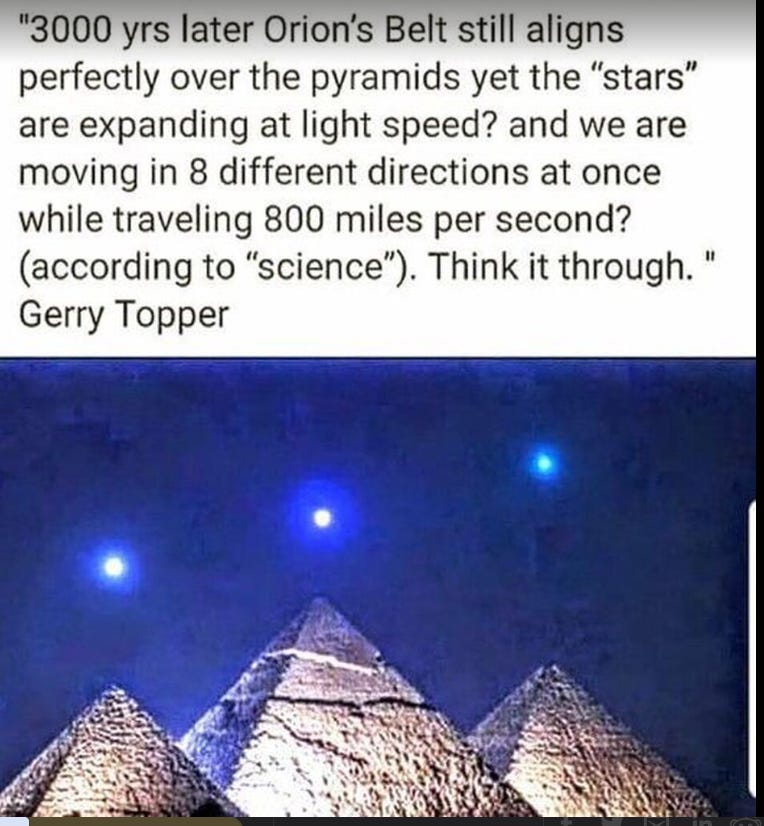
19. Sun, Moon and Stars
20. Rivers flowing down to the ocean
21. Lightning Poles
22. Hot Air Balloons
23. Astrolabe
24. Flat Horizon
25. Water Level / Sea Level
26. Buoyancy not gravity
27. Density not gravity
28. Mass not gravity
29. Balance not gravity
30. Weight not gravity
31. Measure not gravity
32. Airplanes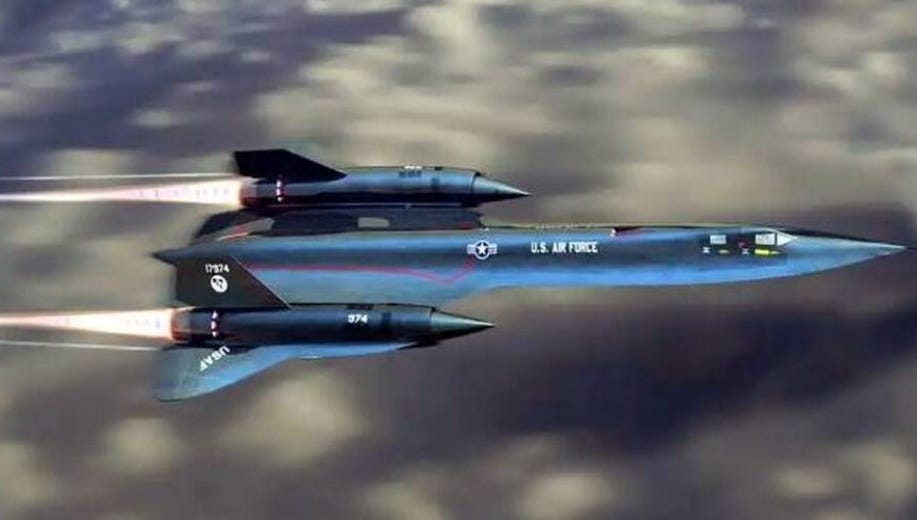
The Lockheed SR‑71 “Blackbird” is rated for speeds up to Mach 3.3—about 2,194 mph—in straight, level flight. If you seriously believe a plane can maintain Mach 3.3 on a curved globe, think again. A craft moving that fast cannot be constantly turning, banking, or pitching to follow some mythical “curvature” of the Earth. It’s not about gyroscopes; it’s about physics. At Mach 3.3, the airframe is under extreme thermal and aerodynamic stress. The slightest hard maneuver, anything other than near‑perfect straight‑and‑level flight, and the plane would start to tear itself apart. If you still think a machine going this fast can smoothly “follow the curve” of a globe, whatever fantasy map you’re staring at, it’s just not possible. At that speed, the plane is basically locked into a flat, level line. Which maybe says more about the shape of the Earth than NASA’s glossy globes ever will.
33. Bullet, cannon, arrow and missile trajectory without coriolis effect
34. Submarines
35. Waterfalls
36. The Winds
37. Gentle Breezes in any direction.
38. Bird Migrations
39. Insects flying not subject to gravity
40. Magnetic North
41. Fountains of the great deep recently confirmed by science
42. Deep ocean currents
43. High Altitude air currents / Slip Streams
44. Thunder Echo
45. G.P.S. otherwise known as tower triangulation
46. Rainbow
47. U.N. logo
48. August 21st eclipse
49. Water flowing North
50. World Temperature Maps not corresponding to earths alleged tilt
51. Crepuscular Rays
52. Localized Sunrise and Sunsets.
53. Stars seen through the Moon
54. Sun and Moon the same size
55. Topography
56. Atmosphere hits a dome, not the vacuum of space
57. Planes cruising at set levels without having to dip down to allow for curvature
58. Common Sense
59. Sundogs
60. Our 5 senses
61. Smoke signals
62. Fireworks
63. Volcano ash and smoke
64. Flight Paths and distances and emergency landings that are bizarre
65. Clouds behind the sun
15 of the flattest places on earth with links to pictures of those places:
Salar de Uyuni, Bolivia - https://www.nationalgeographic.com/travel/destinations/south-america/bolivia/salt-flats-salar-de-uyuni/
Mungo National Park, Australia - https://www.nationalparks.nsw.gov.au/visit-a-park/parks/mungo-national-park
Dasht-e Kavir, Iran - https://www.lonelyplanet.com/iran/attractions/dasht-e-kavir/a/poi-sig/491290/361013
Bonneville Salt Flats, USA - https://www.nps.gov/bhsa/learn/historyculture/speed-record-legacy.htm
Dhala Wadi, India - https://www.holidify.com/places/pune/dhala-wadi-sightseeing-121185.html
The Nullarbor, Australia - https://www.australia.com/en/places/margaret-river-and-southern-forests/guide-to-the-nullarbor-plain.html
The Sahara Desert, Africa - https://www.nationalgeographic.com/environment/habitats/desert/
The Great Plains, USA - https://www.nps.gov/tapr/learn/nature/plants.htm
The Serengeti Plains, Africa - https://www.nationalgeographic.com/travel/destinations/africa/tanzania/serengeti-national-park/
The Outback, Australia - https://www.australia.com/en-us/places/darwin-and-surrounds/guide-to-the-australian-outback.html
The Patagonian Steppe, Chile and Argentina - https://www.nationalgeographic.com/travel/destinations/south-america/chile/patagonia/
The Arafura Plain, Australia - https://ontheroadtofindout.com.au/arafura-plain/
The Altai Mountains, Russia and Mongolia - https://www.lonelyplanet.com/russia/altai-mountains
The Pampas, Argentina - https://www.argentina.travel/regions-of-argentina/pampas/
Vasyugan Swamp, Russia - https://www.mnn.com/earth-matters/wilderness-resources/stories/vasyugan-swamp-russia
Kansas
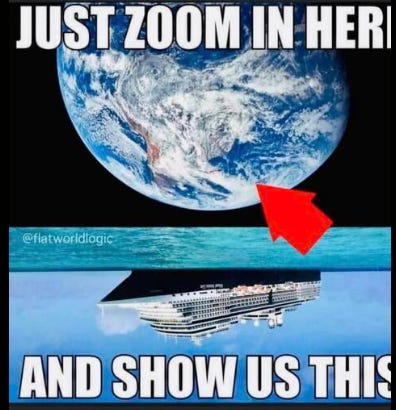
NOW for those saying they live on a ball. Please provide me with photos of the curvature of the earth.
71% of the Earth’s surface is covered by ocean, leading some to believe that the Earth is a disc.
Kansas is famously flat, with no significant hills or mountains, leading some to conclude that the entire Earth is flat.
From certain places in Chicago, it is possible to see the Michigan shoreline, leading some to believe that the Earth is flat.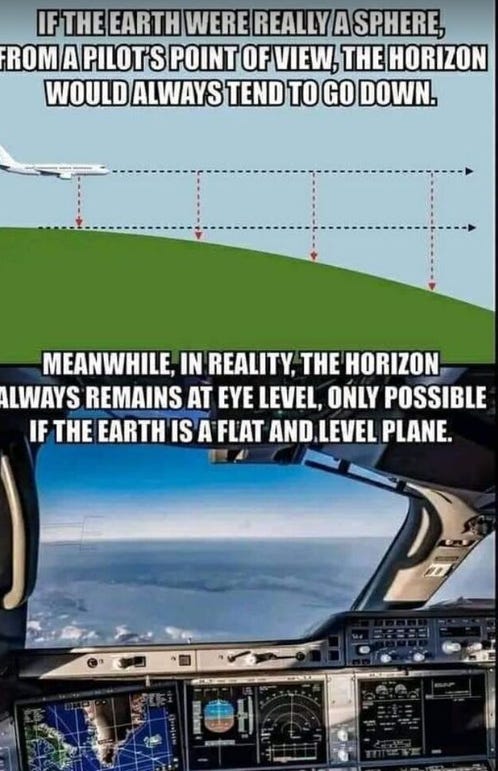
The horizon appears to be flat, suggesting that the Earth is flat.
Ancient civilizations believed that the Earth was flat.
It is claimed that the sun and moon are the same size in the sky, which is not possible if the Earth is a sphere.
Sailors claimed to have seen the edge of the Earth, suggesting a flat edge.
There is no observable curvature of the Earth, leading some to believe that it is flat.
The Earth appears to be two-dimensional in photographs taken from space.
The Bible states that the Earth is flat.
Maps of the Earth are typically flat, suggesting the Earth is flat.
The Earth’s gravity is not strong enough to hold a spherical shape.
There are no visible stars in the sky, leading some to believe that the Earth is in a dome.
It is claimed that air travel and GPS would not be possible if the Earth were round.
Flight routes appear to be straight lines, suggesting that the Earth is flat.
It is claimed that the Earth is the center of the universe and that the sun and stars revolve around it.
There is no evidence of a curvature of the Earth in photographs taken on the ground.
It is claimed that the stars are too far away for the Earth to be round.
It is claimed that time zones would not exist on a round Earth.
It is claimed that the Earth does not rotate because there is no centrifugal force.
It is claimed that the Earth is a flat disc with an infinite edge.
The horizon always appears flat, regardless of the observer’s location.
Maps of the world have depicted the Earth as flat for centuries.
Ancient civilizations, such as the Greeks, believed in a flat Earth.
The Bible references a flat Earth in several passages.
71% of the Earth’s surface is covered by oceans, making it appear flat.
The Sun, Moon and stars all appear to move in a flat plane.
Kansas is known as the flattest state in the U.S.
From certain vantage points, people can see the opposite shore of Lake Michigan.
The Earth’s curvature is not visible at most altitudes and distances.
Some ancient civilizations believed that the Earth was the center of the universe.
A flat Earth would explain the differences in day length at different latitudes.
Ancient sailors and explorers used a flat-Earth model to navigate.
Flat-Earth models can explain why the Sun appears to set at different times in different locations.
Since the Earth is spinning, it would appear flat if viewed from a stationary point.
Some ancient astronomers believed that the Earth was stationary and flat.
NEWS NEWS read all about it.. Earth is getting flatter..
https://www.usu.edu/geo/geomorph/kansas.html
Seem states are losing their curve.. Kansas can not find its 8 inch slope.
Chicago can see Michigan Lake Shore line 59 miles away.
Michigan and Illinois losing its 8 inch curvature of the earth..
Where is the 8 inch slope in a mile?Measure not gravity: The flat world's inhabitants use alternative measurements that account for density, mass, and balance instead of gravity.
Airplanes: Aircraft navigate the flat expanse without the need to account for Earth's curvature, following straight paths across the surface.
Bullet, cannon, arrow, and missile trajectory without coriolis effect: Projectiles move in straight lines without being influenced by any Coriolis effect, simplifying their trajectories.
Submarines: Submersibles travel across vast flat oceans without the need to adjust for Earth's curvature, exploring the underwater world without gravitational constraints.
Waterfalls: Waterfalls cascade down the flat terrain, defying the expectations of how gravity shapes these natural features.
The Winds: Winds blow freely across the flat world, unaffected by the curvature of the Earth. Gentle breezes can occur in any direction.Flat Horizon: The world is truly flat, extending endlessly in all directions without any curvature. The horizon remains at eye level regardless of the observer's position.
Water Level / Sea Level: Bodies of water conform to a flat surface, with sea levels determined by the equilibrium of buoyancy rather than the influence of gravity.
Buoyancy not gravity: Objects and substances experience buoyancy based on their density rather than gravitational forces, challenging traditional physics.
Density not gravity: The density of materials determines their behavior, affecting how things sink or float in bodies of water.
Mass not gravity: Mass influences the interactions between objects, determining their gravitational effect on each other within this unique flat world.
Balance not gravity: Objects find stability and balance based on their shapes and masses, rather than relying on gravity to keep them grounded.
Weight not gravity: Weight is a measure of the mass's interaction with the flat world rather than being influenced by gravitational forces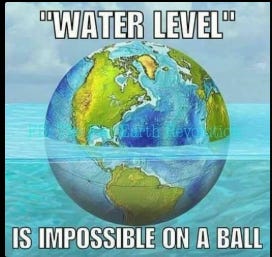
If earth is covered in 71 percent of water does that not mean it is level?
If 33 percent of the worlds ground is desert and most of it is flat. Does that not mean this area too is mostly flat?
If farm land is mostly flat - Globally agricultural land area is approximately five billion hectares, or 38 percent of the global land surface.May 7, 2020 -
Where exactly is the curvature of the world?
i think the most liberating part of restriction is I can use my imagination now and call out a few other thins. even if I do not believe them.. But for the fun of it..
shhh.. we do not live on a ball..
https://www.brake-magazine.com/travel-flattest-place-earth-salar-de-uyuni/ Travel – The Flattest Place on Earth – Salar de Uyuni
71 percent
About 71 percent of the Earth’s surface is water-covered, and the oceans hold about 96.5 percent of all Earth’s water.Nov 13, 2019
Water level, also known as gauge height or stage, is the elevation of the free surface of a sea, stream, lake or reservoir relative to a specified vertical datum.
Deserts make up about 33% of earth’s land area. Polar deserts make up around 14.2 million square kilometer of earth’s area. Sahara desert covers around 3.3 square miles. Deserts hence make around one third of the world’s total land area
https://www.minds.com/newsfeed/1437276993467977742
Always be willing to truly consider evidence that contradicts your beliefs. Admit the possibility that you may be wrong. Intelligence is not knowing everything. It is the ability to challenge everything you know.
1. It sort of looks flat, doesn’t it?
2. It’s cheaper to fake journeys into space than it is to journey into space
https://www.express.co.uk/news/science/1236599/moon-landing-fake-apollo-11-truth-neil-armstrong-buzz-aldrin-nasa-spt
3. Satellite photos are ‘easily faked’
4. ‘Day’ and ‘night’ are created by the sun orbiting in a circle above, then beneath the North Pole
The sun also moves sideways – hence winter and summer. They think of everything!
5. People who think they’ve flown round the Earth have just travelled in a big circle round the North Pole
The Earth is like a pancake, with the North Pole in the middle, see.
6. It all stays together because there’s a big ice wall round the edge
The oceans don’t spill off because there’s a wall of ice – called Antarctica.
7. Gravity doesn’t exist
Instead, the Earth is constantly accelerating upwards, so the force of gravity is like being pushed into your seat in a car, see?
8. Earth is accelerating upwards due to ‘dark energy’
https://science.nasa.gov/astrophysics/focus-areas/what-is-dark-energy
9. Photos from aeroplanes look curved because of the windows
https://aviationforaviators.com/2022/01/18/why-are-the-windows-of-planes-round-or-curved/
10. An experiment proved that a six-mile stretch of water was flat https://en.wikipedia.org/wiki/Bedford_Level_experiment